After visiting the Wakhan Corridor in Afghanistan, I continued to explore the Pamir on the Chinese side. The famous Karakoram Highway stretches into the Chinese Pamir, in the Xinjiang Uyghur Autonomous Region. It is designated as the G314 Highway in China, running from the southwest of Urumqi, Xinjiang, toward Khunjerab Pass. Khunjerab Pass, at an elevation of 4,693 meters, is a tourist destination for Chinese visitors and occasionally for Pakistanis. When I visited, I did not see Pakistanis on the other side of the border; instead, I saw businesses catering to mainland Chinese tourists. Portable oxygen canisters, including pillow-sized ones, were available in convenience stores near the Chinese border.
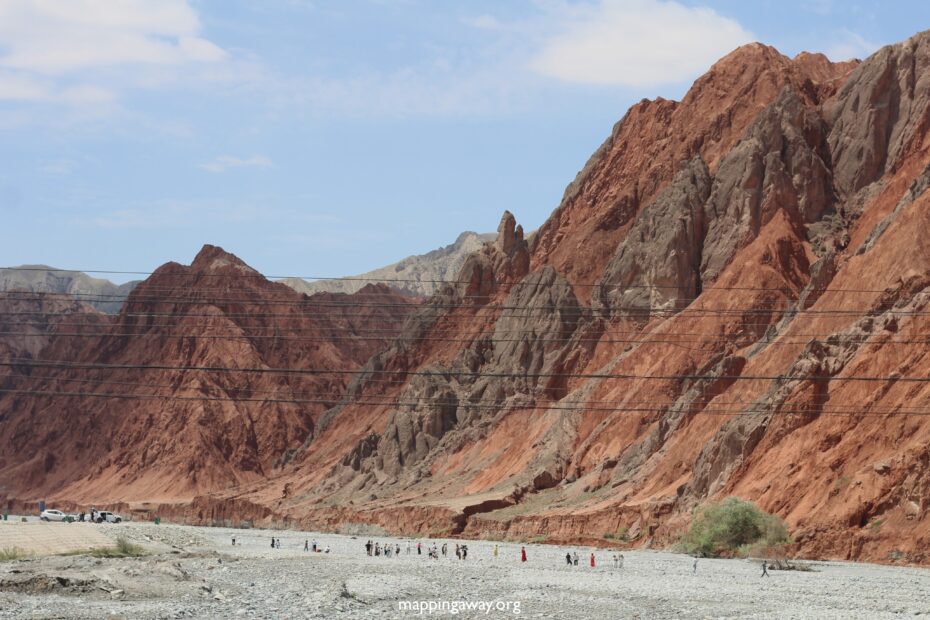
The drive from Kashgar to the Pamir is an epic road trip. The highway is newly constructed and paved; along it, the ruins of the old highway can still be seen. Soon, the entrance to the Pamir appears, with the highway encircled by giant mountain ranges. These ranges appeared in reddish-brown, golden, and sandy hues, contrasting with the green meadows that served as oases for horses and sheep. There were only two sightseeing places that I wanted to visit in Tǎxiàn (塔县): the Panlong Ancient Road and the Wakhan Corridor. My Uyghur driver, a retired public servant who had once been stationed in a village not far from White Sand Lake, reminisced about his younger days as we drove along the highway.
People in Tǎxiàn (塔县) aka Tashkurgan/Taxkorgan
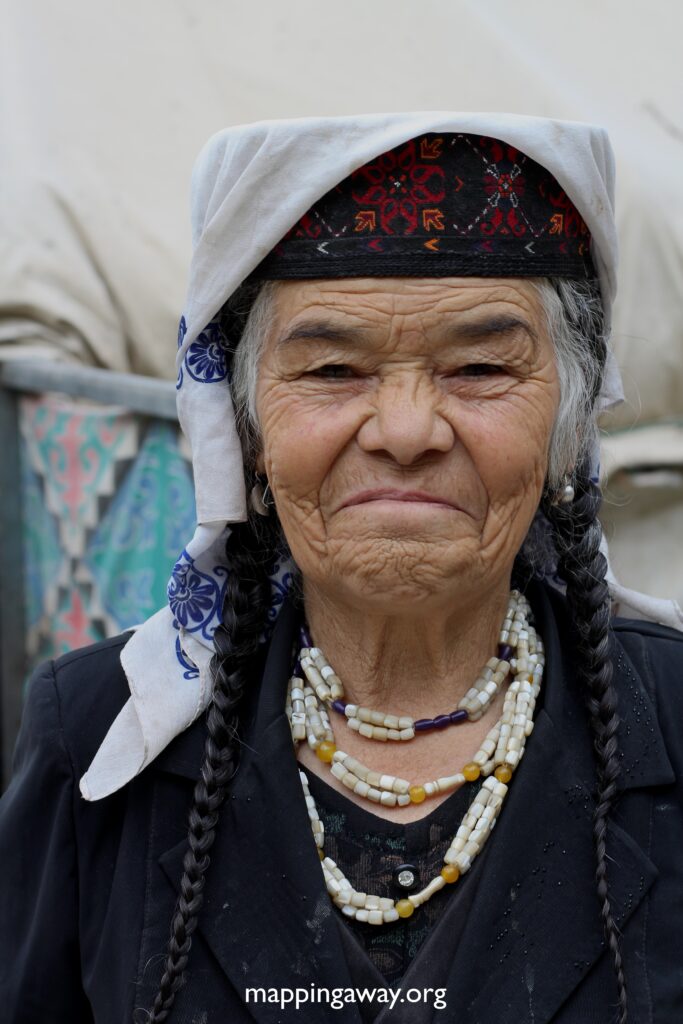
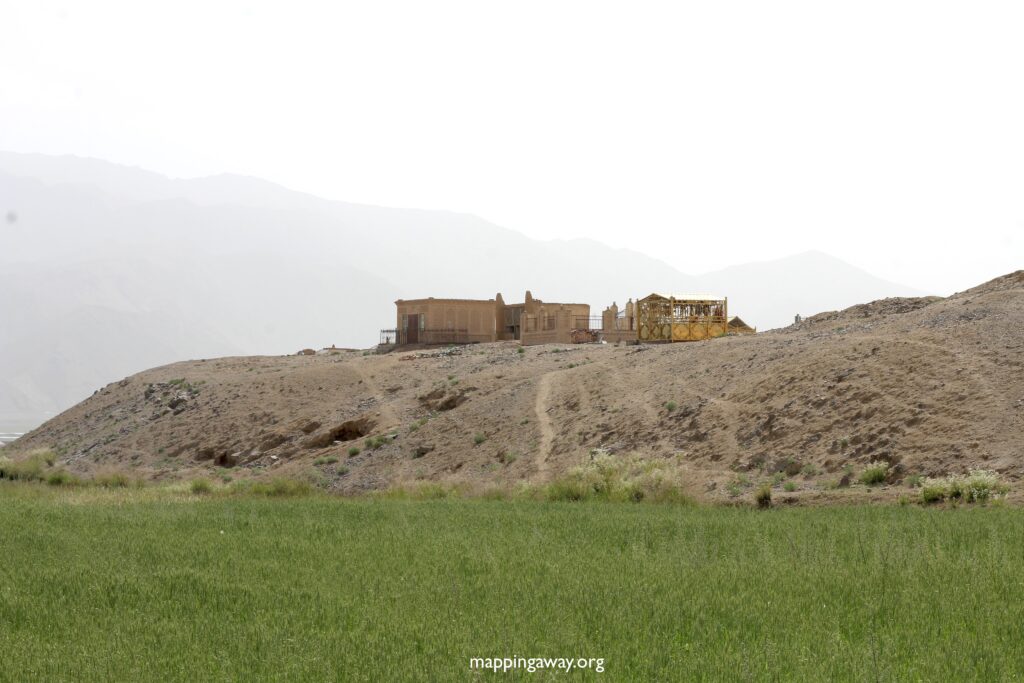
Taxkorgan is commonly known as Taxkorgan Tajik Autonomous County (塔什库尔干塔吉克自治县), aka Tǎxiàn (塔县). It is inhabited by Tajiks, who are distinctly different from the Tajiks of Tajikistan. I was curious if any of them share a family link on the other side of Pamir. Of course, it seems too ancient for the Tajiks to trace. Tǎxiàn (塔县) is a quiet town and the main tourist hub, with hotels, restaurants, and bus terminals. The women wear traditional Tajik clothing in public spaces and at workspaces, and always pair it with a tubeteika (embroidery skullcap), but not men so much. An old cemetery has become a ruin behind where I stayed and only a few gated mausoleums stand strong. All the tombs are gone without a trace. The secret stays with the elders.
Languages
Now, with the push for Mandarin-language education policies, their children are being educated primarily in Mandarin. As bilingual education is phased out in China, it has had a significant impact on these languages, including those with their own writing systems. Tajiks over the age of 40 were educated in Uyghur as part of the former bilingual education system and continue to use the Uyghur alphabet for daily communication. Not being an expert on the language, I am not entirely sure which areas speak Sarikoli and which speak Wakhi. However, it is most likely that the villages surrounding Tǎxiàn (塔县) primarily speak Sarikoli, while communities closer to Afghanistan speak Wakhi. Please share your thoughts if you know more.
After elementary school, many young people attend boarding schools for middle and high school, returning home only during holidays. When visiting during the summer, children can often be seen playing outside or spending time with friends while looking at their phones. When asked about their Tajik language abilities, many children reply that their Mandarin is better than their Tajik, although this is not always the case. Sometimes the younger generation struggles with code-switching when speaking with their parents. At the same time, high school students are often able to express more complex ideas in conversations with their families, discussing topics such as technology and medicine. They scroll through both Tajik and Mandarin language content on Xiaohongshu. High school students are frequently asked whether they plan to return to Tǎxiàn (塔县) or their home villages after taking the Gaokao, China’s national university entrance examination. The ones I talked to told me that their parents hope they will find employment and settle in the area.
Traditions
Similar to the Tajiks and Wakhis, Chinese Tajiks are Ismaili. There is a small group of Tajiks who are Sunni Muslims. In China, according to Chinese Tajik scholar Amier Saidula, Tajiks often practice their religion through informal rituals and customs, such as visiting shrines and sacred sites, and celebrating festivals. This is treated as an ethnic culture rather than a religious practice. In “Landscapes of Spirituality: The Topography of Ismaili Sacred Sites in Xinjiang, China,” Saidula highlights that very few Tajiks can recite prayers in Persian or Arabic today when they are visiting shrines or sacred sites (368). When I asked younger generations to explain what they do when visiting a mazar (the burial place of a saint or holy man). They usually shared memories of going there with their grandparents, or described it as a place where elders go for prayer, rather than something they personally experienced.
Homestay or Guesthouse in Tǎxiàn (塔县)
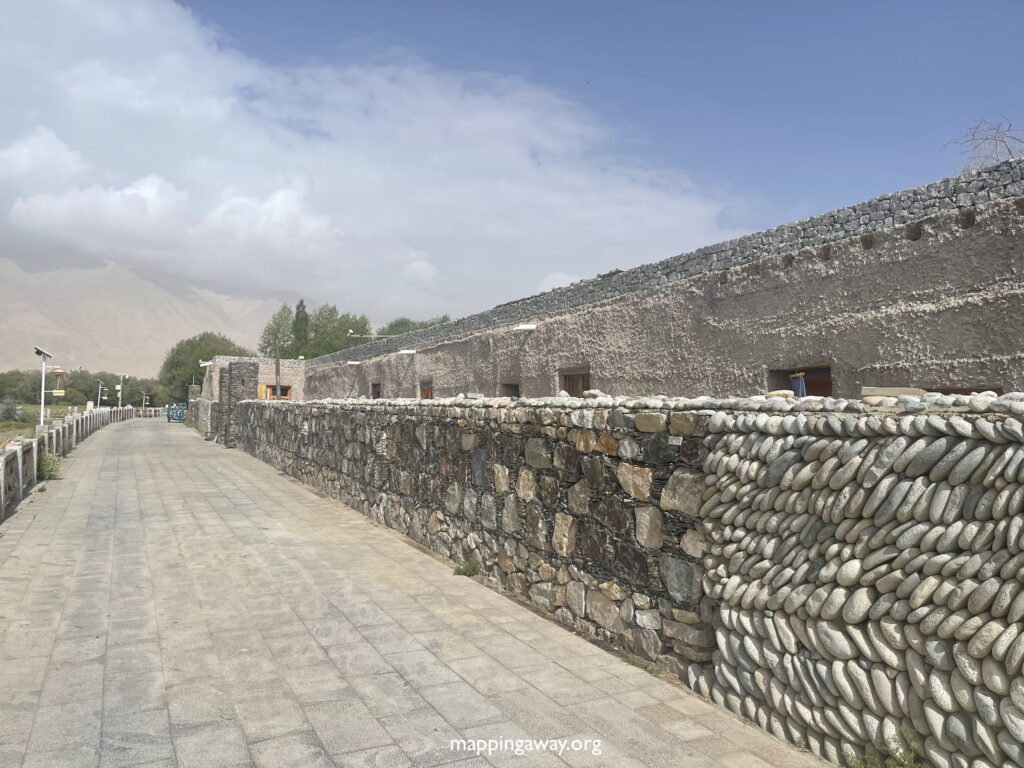
Along the G314 Highway, look for Youyi Gas Station (友谊加油站) on your Gaode Map. There is a small alley in the neighborhood where all the homestays are located. It seems that this neighborhood is part of a tourism pilot project designed to involve residents. Almost all the houses have a built-in spare living space in the traditional Tajik style. It is a quiet neighborhood with neatly paved roads. My homestay faced the farming fields, offering an expansive view of the surrounding mountains. You can still observe daily life here, including farming and herding. In most cases, the parents are working while the children attend boarding school.
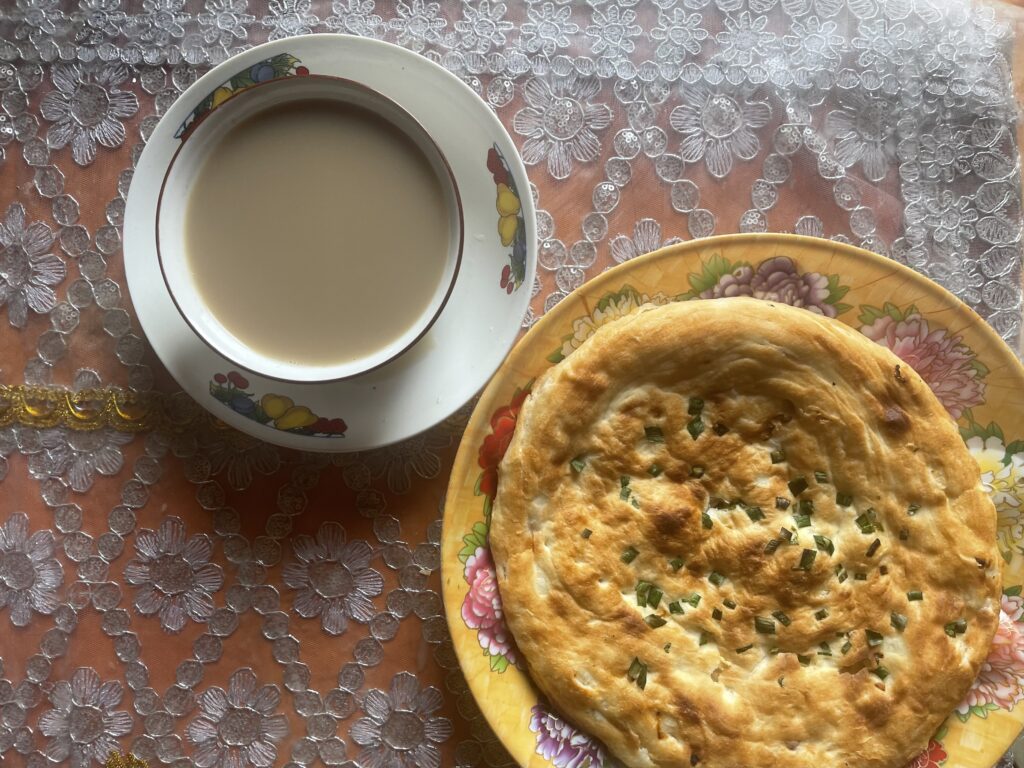
When I knocked on the homestay door, the children opened it for me. At the age of 12, they are translating between their parents and me in Mandarin. It reminded me of the younger me when I was translating for my parents. I was the only guest in a large room, shared a bathroom with the family, and was served milk tea and nan for breakfast. Besides the house, an animal shelter for cows and sheep. Yogurt wrapped in a Muslim cloth hung on the wall. The mother worked at a local restaurant and only came home during breaks and in the evenings. One night costs ¥70. The accommodations are very basic, with squat toilets, and may not always be perfectly clean. You can always visit a few more homestays before making a decision.
Tǎxiàn (塔县) is a small town, and many villages can be reached by taxi within 20 to 30 minutes. The roads around the homestays led me to the farming fields behind the neighborhood. The locals are very welcoming and often want to add you on WeChat.
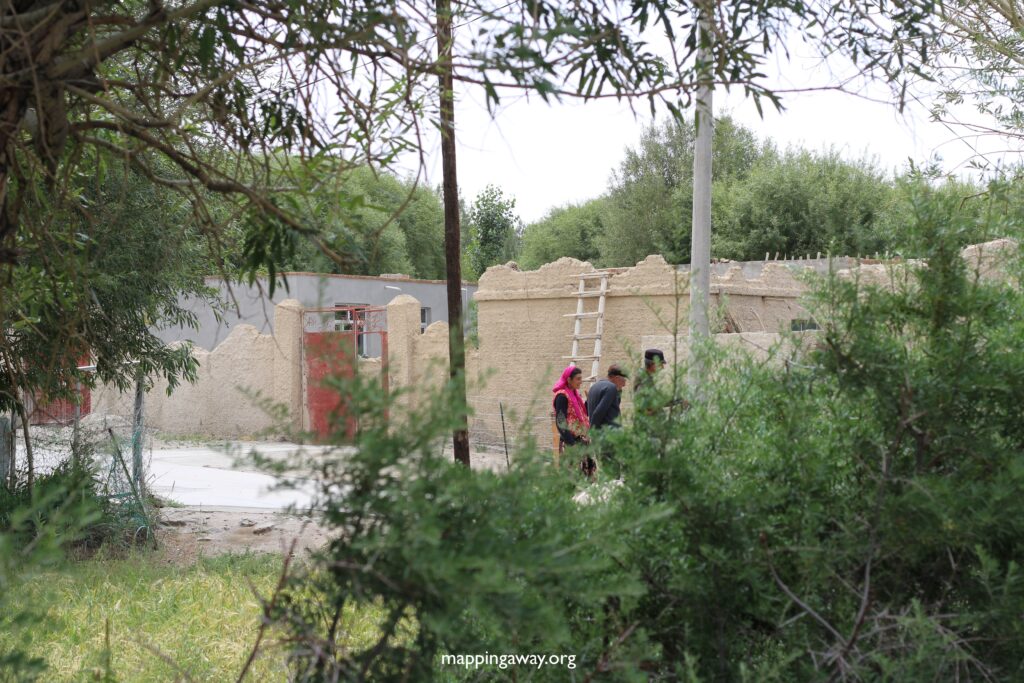
TuoGeLunXia Village (托格伦夏村) is a growing tourist village known for its quaint atmosphere and meadows. Yurts are scattered across the grasslands, and you can hear dogs barking in the distance long before you get close. With limited transportation to TuoGeLunXia Village, taking a taxi is the most convenient option. If you do, negotiate the pickup fare as well. Although new houses have been built in all the villages, some Tajiks still maintain their old mud houses, complete with courtyards for animals and a fire stove in the living room, similar to the traditional homes found in the Tajik Pamirs.
Tǎxiàn (塔县) Permit at Kashgar
For everyone, except residents of Tǎxiàn, a Border Management Area (边境通行证) Permit is required, as Tǎxiàn is closed to the borders with Pakistan, Tajikistan, and Afghanistan. There are more places for Chinese to apply for the permit, but for foreigners, I am aware of two places.
- Kashgar Airport Terminal 2 Departure Police Station.
- Kashgar Area of the China (Xinjiang) Pilot Free Trade Zone (中国(新疆)自由贸易试验区喀什片区): This is the office where you can obtain the permit if you missed getting it at the airport. It takes about 15 minutes to process the application, but the waiting time can be around an hour, depending on the number of people ahead of you. On the summer solstice, Kashgar enjoys long daylight hours, with sunset at 10:20 PM. The working hours of public offices operate on a different schedule. They are open from 10:00 AM to 2:00 PM and again from 4:00 PM to 8:00 PM (Beijing Time).
- Good News! You can apply for a permit digitally. You have to download China Immigration 12367(中国移民局12367), and English is available. I have not used it, so I cannot comment on it.
Are spring and summer the best times to visit?
To visit the surrounding villages and sightseeing, spring and summer are the best times, and they are accessible. Spring is the apricot blossom season in villages. I visited during the summer, it is apricot harvest time. You will have endless apricots to enjoy, juicy and sweet. Either season urges you to enjoy the local culture.
Transportation and Tours
The best way to visit Tǎxiàn (塔县) and the tourism sights is by car. Public transportation does not go to sightseeing spots.
- It is easy to find travel partners to share an SUV from the guesthouse in Kashgar.
- Join an organized tour for 4 to 6 days for approximately ¥2500-3000 RMB for a group of 4 to 5 people. My guesthouse was very helpful in checking the tours for me.
- A private driver for a sedan costs approximately ¥800 RMB a day.
Landslide: How often?
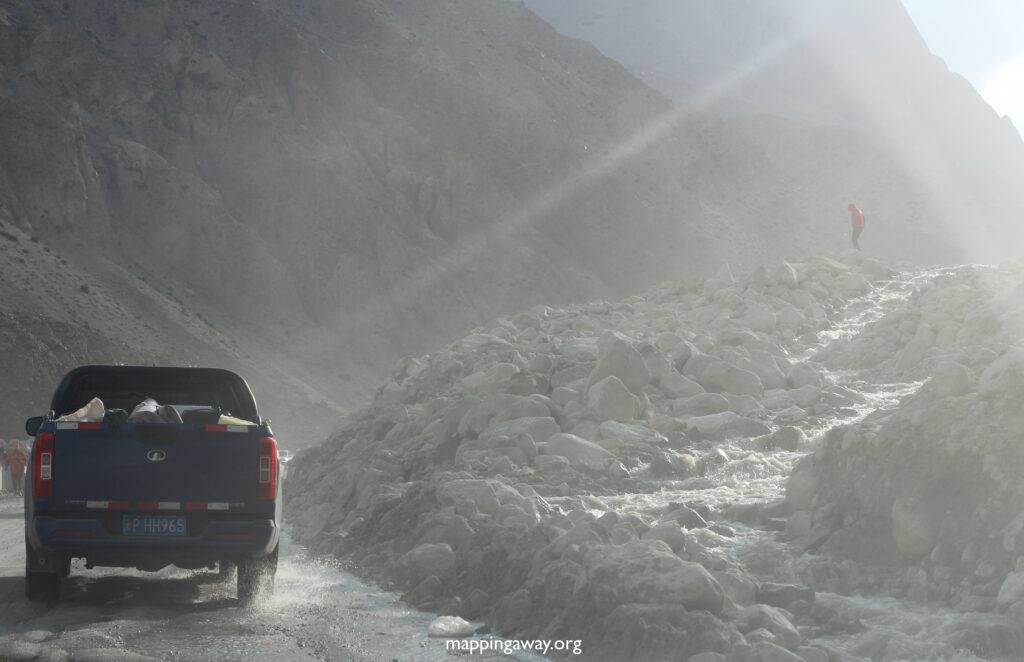
It meant that winter in the Pamir was normal, with white snow-capped mountain ranges everywhere. Nature is in control in this harsh environment. As the weather warmed up in the Pamir, on both the Afghan and Chinese sides, the snow melted fast and turned into rushing rivers. While in the Afghan Pamir, we have to cross a shallow-running river before 3 PM, as requested by the driver. Sometimes, people thought that crossing the highway before noon was the best option. While I was in Kashgar, I listened to stories of people missing flights and being stuck because of landslides for more than ten hours. Where the landslide occurred, there were no shops or stores in the area. It happened that people went without food while stuck on the highway. My driver got news from his friends that the highway was clear, and we started our journey early in the morning. We did not beat the melting snow; eventually, we were stuck there for about five hours.
Panlong Ancient Road
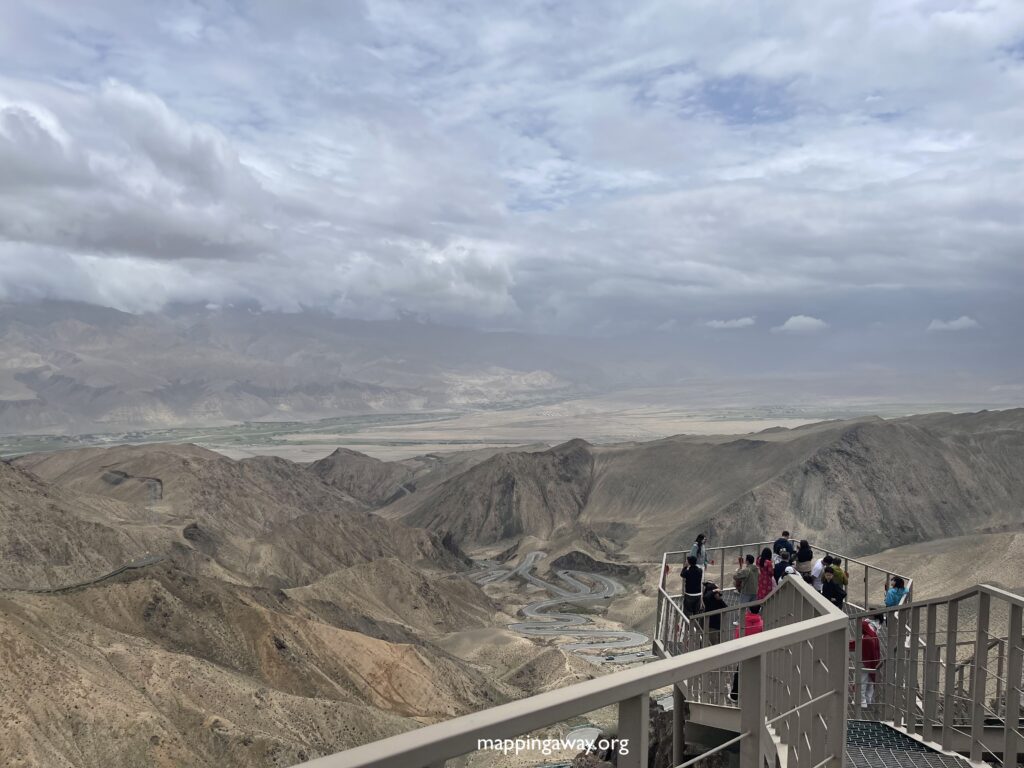
The highest point of elevation is above 4,000 meters along this road. It has more than 600 curves; my driver carefully turned the steering wheel and tried not to brake hard. It was built in 2019. The road is newly paved, built over modern routes rather than old, ancient paths. The area is associated with the historic Silk Road. It was built to connect to nearby villages; over time, it has become a tourist destination. Many photographic spots have been developed, and drone photography is popular. The curves definitely make you feel dizzy. The views from the viewpoints are vast, with sparse greenery and a rather dusty landscape.
Wakhan Corridor
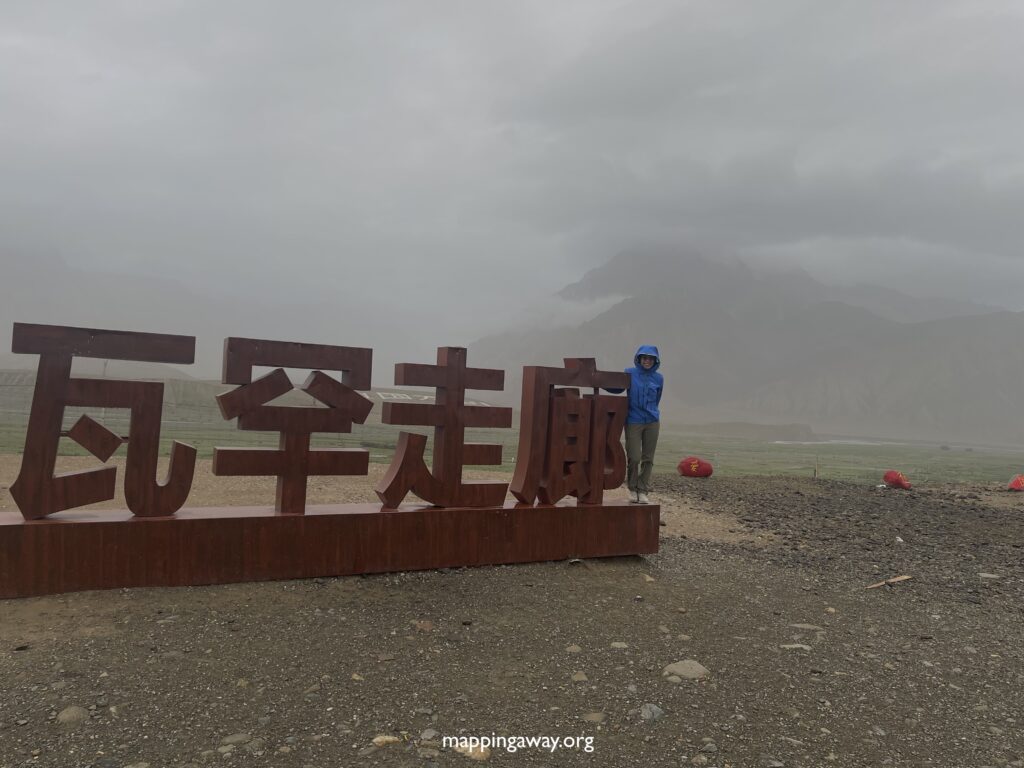
We left the hotel as early as 6 AM, driving toward the Afghanistan border. When I asked if there was a village closest to the border, my driver told me there is no road to go beyond the tourist parking lot. I doubt it. The morning felt chill and foggy. We heard dogs barking from far away in the meadow. While standing behind the sign of the Wakhan Corridor in Chinese, the historical stories of Xuanzang went through this place. The border is a narrow strip in an open valley, with a backdrop of the ranges. This area was less exciting than I had expected. Across the metal barrier, there was a pile of cow dung, and its owner was waiting to collect it. The guesthouse owner warned me to skip the Wakhan Corridor viewpoint, saying that it did not offer much beyond the view of the large Chinese characters on the mountainside. Since my last visit to Afghanistan’s Wakhan Corridor, the Taliban have become extremely active in the area, and there has been discussion about building a highway to connect the two countries. Based on a conversation I had with a Taliban general, they are well aware of what is happening across the border, and intelligence is actively collected.