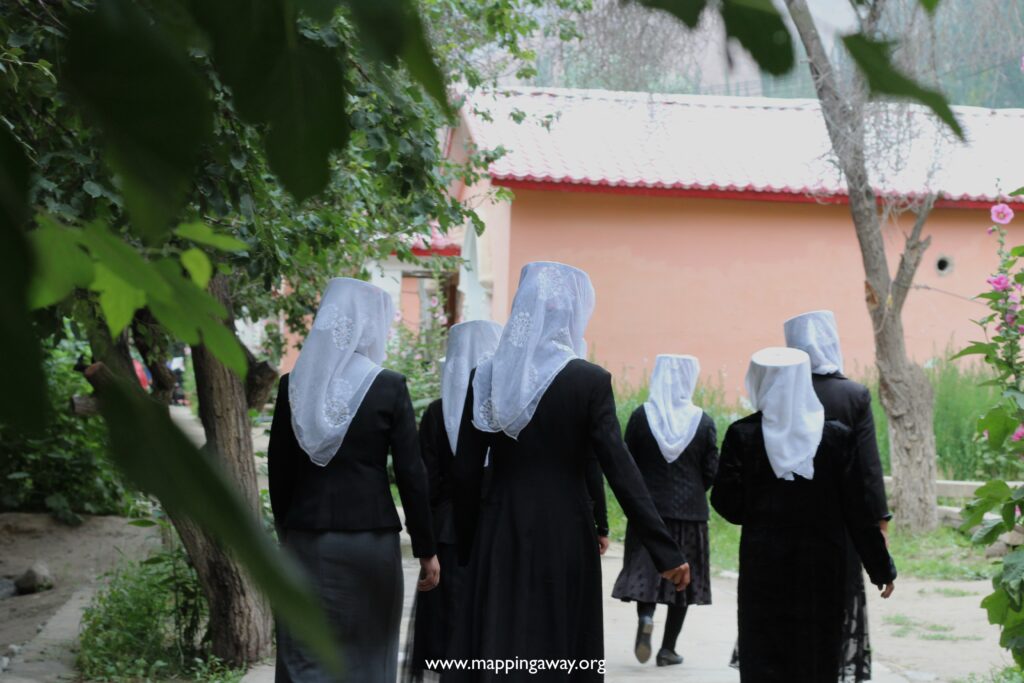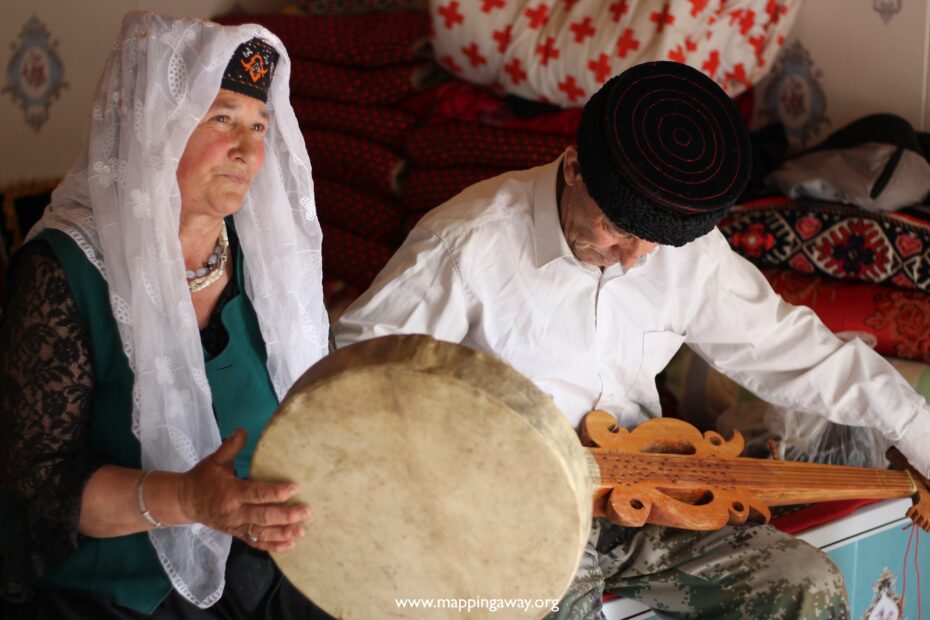
Off the Tasha Ancient Road (塔莎古道), a small road branches off that leads to Da Tong Xiang (大同乡). Da Tong Xiang is an administrative township of several villages. Houses built narrowly on the edge of the mountain valley and along the raging river that connects the Yarkant River. Based on Chinese media sources, “Tong” means a narrow valley in Tajik, and “Da Tong” means nestled in the deep valley. Standing in the center of town, I gazed at the foot of the mountains and slowly lifted my eyes to the top. Turning around, I suddenly found myself surrounded by mountain ranges. I only see a piece of bright sky and the starry night. Imagined that if I wanted to see beyond the village, I would have to hike up to the mountain. I wondered if that is how the people feel.
Tasha Ancient Road (塔莎古道) connects Da Tong Xiang to Yarkant County ( Shache County 莎车); however, numerous landslides have accumulated on the road awaiting cleanup. This road is about 300 KM, and 270 KM is not paved. The road is built on the cliff, which many drivers and locals consider dangerous. I was asking around the local drivers if anyone was going to Shache and during my stay, I did not hear from them.
Falling rocks are common on the road. The Yarkant River is roaring after a heavy rain. Da Tong Xiang is located at a lower elevation than Tashkurgan, aka Tǎxiàn (塔县). The road curled tightly through mountains, with massive mountains pressing in on both sides. My Tajik driver’s long curly hair was flying in the air; his hairstyle made him stand out when I was looking for him at the gas station. I use “Tajik” as a general term for the people living in the Pamirs, even though many are Sarikoli speakers.
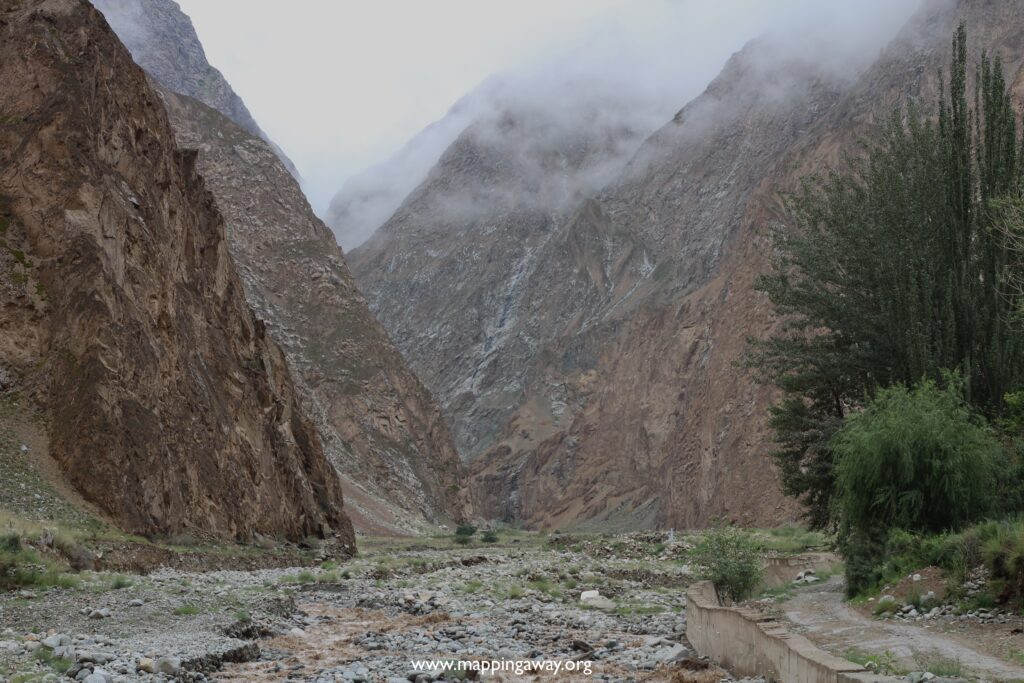
Checkpoint & Non-Chinese Passport Holder
There is one checkpoint before I get to Da Tong Xiang. When the facial recognition could not identify me, the border soldier approached me to ask if I had an identification card. I told my driver that I do not have a “shenfen zheng / identification card.” The soldier gestured for me in the direction of the office. The office’s light was off, and a female soldier sat behind the counter. I passed my passport under the glass. She examined my passport and wrote down the information in a record book. I was free to go, and they did not ask me any questions. The soldier only confirmed with me whether there are hotels that can accommodate foreigners in Da Tong Xiang. After I told him that I found a homestay, he nodded his head. I would say they were friendly.
Homestay 民宿 (mínsù)
¥100 a night with breakfast; ¥15 for dinner (or up to you)
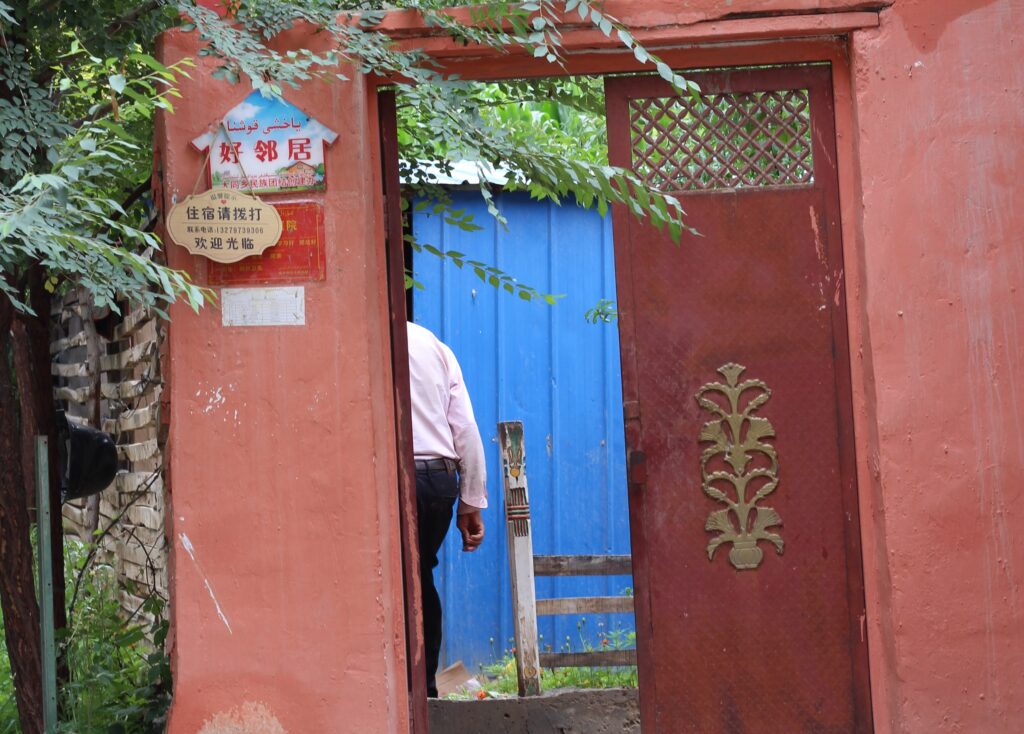
There are a few homestays available in the villages. They either have a sign of 民宿 (mínsù), 住宿(zhusù) or you can walk into anyone, and they will help you to find an accommodation. One observation is that the new houses built for some villagers are part of the Alleviation Poverty Policy, and ironically, many of them prefer to remain in their old homes rather than move into the new houses. Another reason for the small families is that the children are in boarding school, and they prefer their original home. So, the new homes built by the government are used as homestays as it furnished with a toilet, hot shower, and kitchen.
The Uncle of this home, he takes care of his vegetable garden. He grows colorful flowers in the courtyard – reminds me of a home I was invited into in Eskhashim, Afghanistan. It seems common that most of the people have a courtyard, and a bed in the courtyard for a hot summer – I am not even sure if there is a hot summer.
Transportation to Da Tong Xiang
It was difficult to find transportation information from Xiaohongshu (Little Red Book). I decided to walk to the Tǎxiàn (塔县) Tourism Office. Three Tajik girls, mostly slightly older than 18 years old and having finished high school, in traditional clothes, standing behind the reception podium, welcoming guests. When I mentioned transportation to Da Tong Xiang to one receptionist, she immediately called her colleague and told me in Mandarin, “She knows the transportation to Da Tong Xiang.”
I added the driver’s WeChat number, and she booked a homestay for me. The driver only started when he had three passengers for his small jeep. It costs ¥50 for one way. It takes five hours from Tǎxiàn (塔县) to Da Tong Xiang, about 120 KM, winding through mountain roads and rivers. It was after a heavy rain, and there was expected to be more rainfall. The roaring river echoes in the valley, screaming for us.
Homestay Family
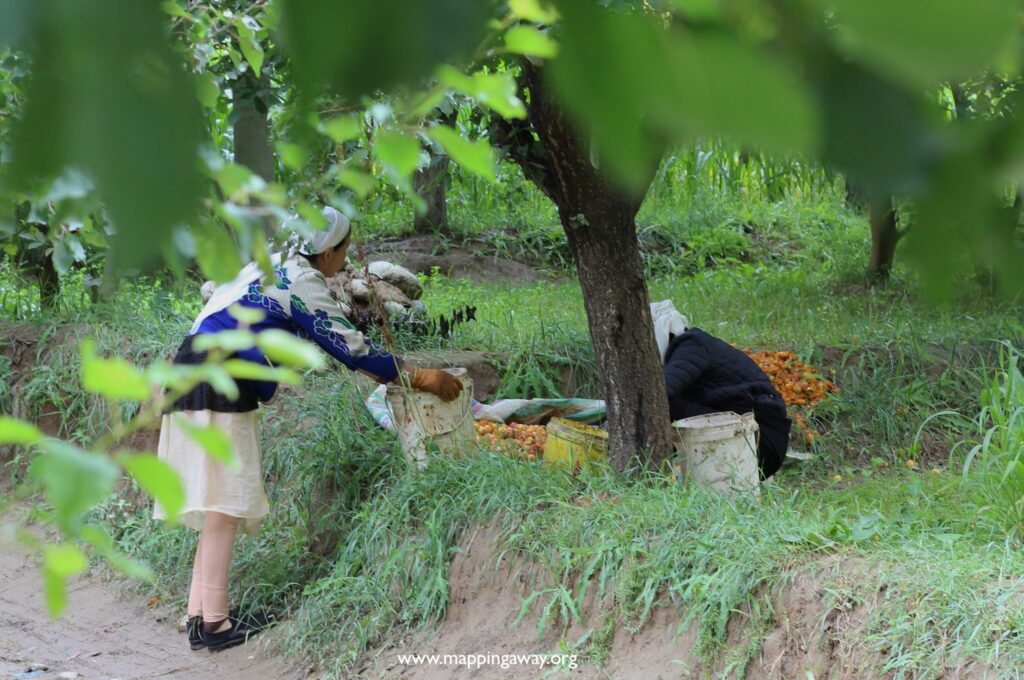
After crossing the bridge, there is Da Tong Xiang. It was 6:24 PM, and the twilight would be in an hour. Sunset is at 11 PM in Kashgar, but it’s earlier here. By then, the temperature dropped to 19 Celcius. The driver dropped me off at the homestay, which is next to the town hall. The mother, in her late 40s, welcomed me into the courtyard, and apricot seeds were on a large tarp on the ground. A large apricot tree leans on the green metal fence, while the bright, light orange apricot hangs behind leaves. The courtyard is small, with a view of mountain peaks behind the roof. She does not speak Mandarin, and I don’t speak either Tajik or Uyghur. So, she pointed me in the direction of my room.
Inside, a traditional Tajik raised platform against the walls, and golden-blue wallpaper. There are four single beds in my room, each with a bed frame. They seemed new. Across the courtyard, another larger house with a toilet, kitchen, living room, and bedroom. The mother uses this new kitchen to cook easy food, boil water, and make tea. Meanwhile, the firewood kitchen is next to the other house, where she made fried dough for breakfast, dinner, or a snack. It is a temporary build; the wall is as dark as charcoal, and the mother sits on a low stool to start a fire in the morning.
This homestay is the family of the receptionist who arranged transportation and a homestay for me. The younger brother had just finished Gaokao and had taken a part-time job at a brick-making factory. That earns him ¥200 a day. Like all the Tajik families that I encountered, either the wife or the husband works as a border soldier, making about ¥2,500-3,000 a month. They are stationed at the high-altitude border for around 20 days, despite the cold weather. The father of this family was on his duty while I was staying at this family. In the meantime, the mother harvested apricots from their farm not far from the water bank, along with other women in the village.
I did not see much livestock around, only houses with small yards facing the mountains, where simple fenced enclosures served as goat pens. The homestay owner’s younger son, told me that his father and grandfather used to take their animals to the meadows and valleys on the other side of the mountains. When I asked whether they still did this today, he said it happened far less often. In fact, he had been there only once, when he was a child. So it really depends on the family finances and house structures.
The police have their eye on me.
The local police knew all the town residents. As I walked to a restaurant under the dim streetlight, a Tajik police officer in his uniform who speaks Mandarin, immediately recognized that I was not a resident. He stopped his motorcycle and asked me, ” When did you get here?” After I told him that I got here two hours ago, he asked me to show him my identification card or passport. He accompanied me to the guesthouse, checked in with the homestay mother, and took a look at my passport. He did not take a photo of it.
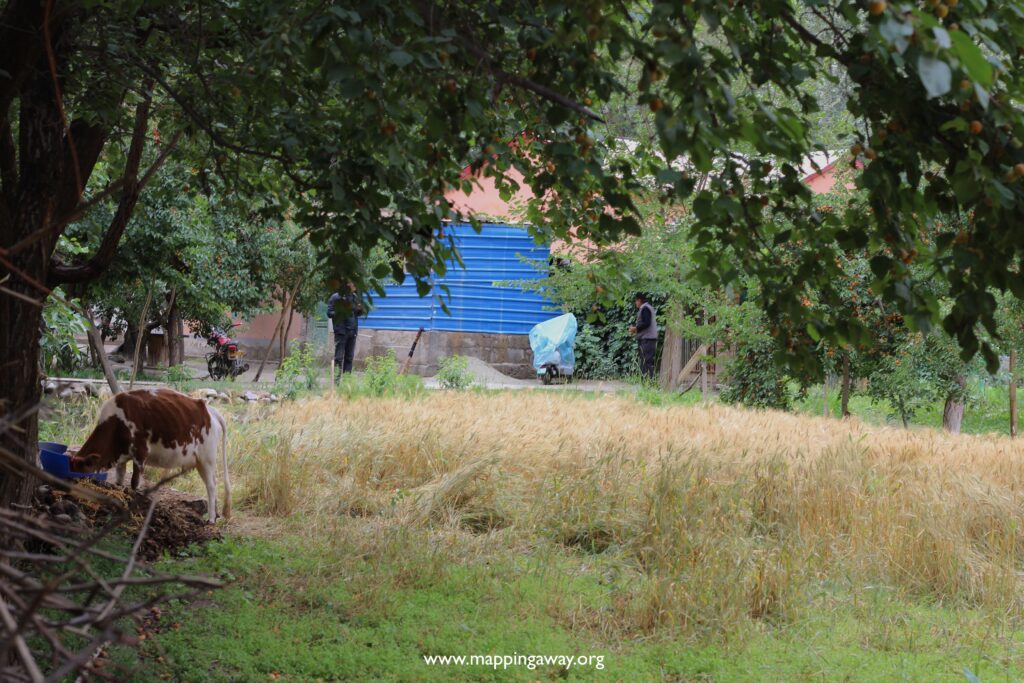
The next day, while I was walking to another village, I stopped to take photos of the wheat fields, chickens, and apricot trees. A black sedan suddenly parked on the roadside, and two ethnic Han men approached me. They are not in police uniform. One man asked in Mandarin, “What are you doing here?” I told him that I was walking around and I liked the wheat field and apricot trees. Then he asked again if he could see my passport. I did not say no. I complied; meanwhile, I asked them to show their ID. As expected, they did not carry them. Before they left, an officer, in both a warning and a caring message tone, said, “Don’t go too far; a flood could happen, and the river is dangerous. Be careful.
Villagers
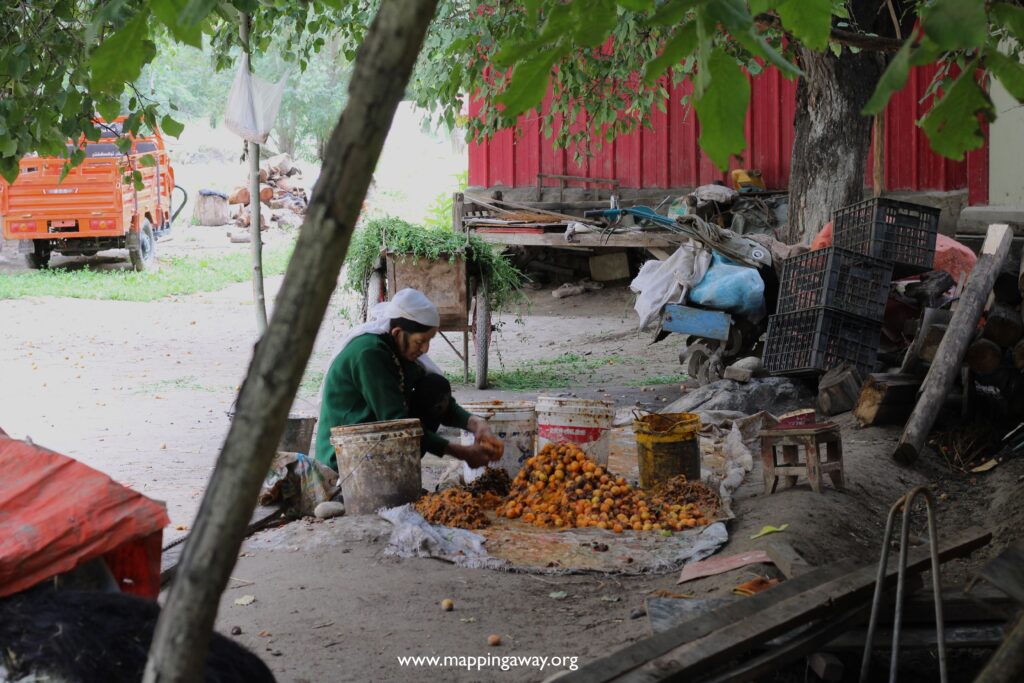
Every family is harvesting apricots. While walking around the village, the fragrance of sweetness is everywhere. The blossom season attracts a few tourists to the corner of this area. Grandmas sat in the garden, next to a pile of rotten apricots, removing the orange flesh and keeping the shell in a metal bucket. In fact, the locals are selling the shells for the kernels. The granddaughters are helping this grandma to remove the apricot flesh.
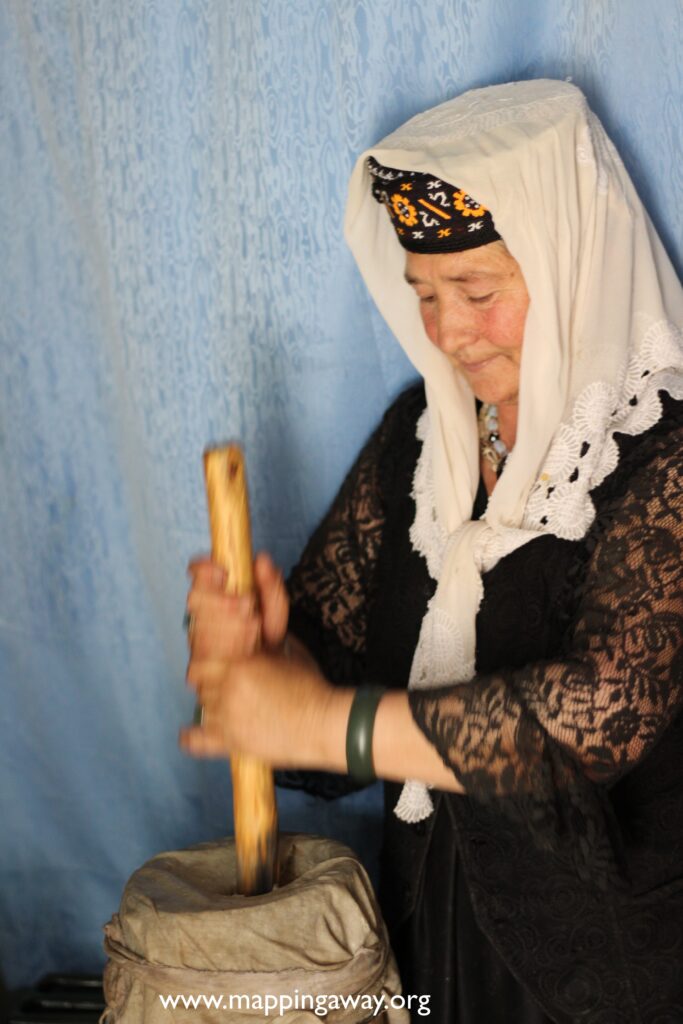
At the end of this road, both grandpa and grandma are picking ripe apricots from the ground, while a goat and a lamb are tied to the tree. A yurt on the other side seems like a temporary yurt, and it is not a storage room. I was invited to her home for tea, and before that, she showed me the butter churn in the storage room, which she is still using. They are grandparents of three fun grandchildren who are visiting them from Aksu County. They translated for us, from Tajik into Mandarin when Grandma spoke. When I asked how often they visit their grandparents, I was told they come only during summer and the New Year. The large courtyard is unpaved, with three rooms, both old and newly built. The grandchildren’s mother is Tajik, but the father is ethnic Mongol. I was curious what language they speak at home. The younger girl said, “We speak Mandarin at home.” It seems that they only speak Tajik while visiting the grandparents or maybe with some friends.
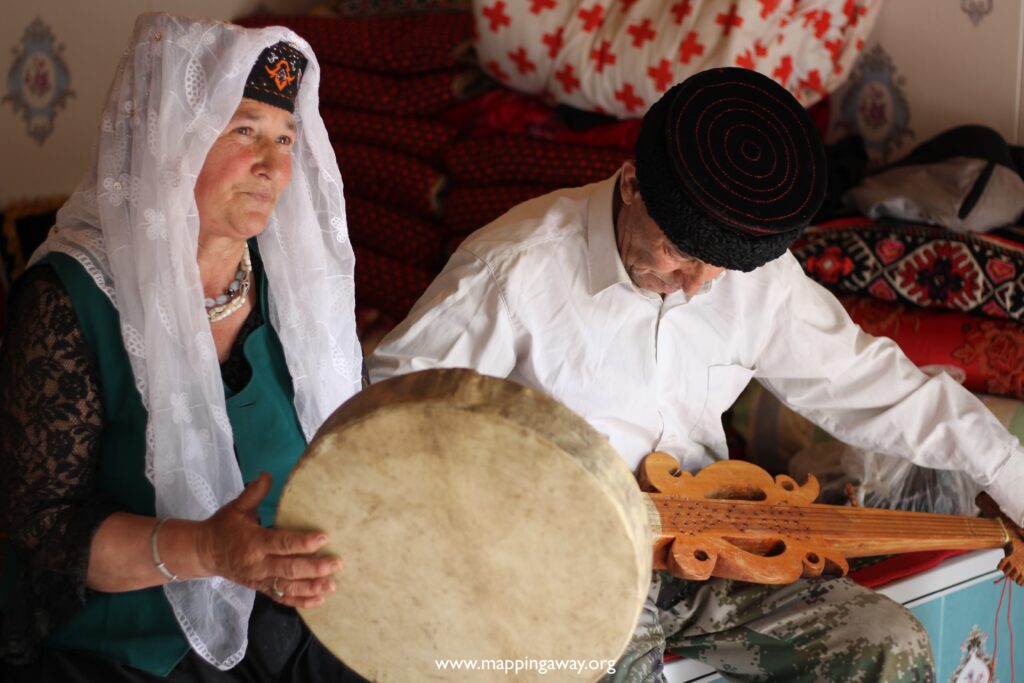
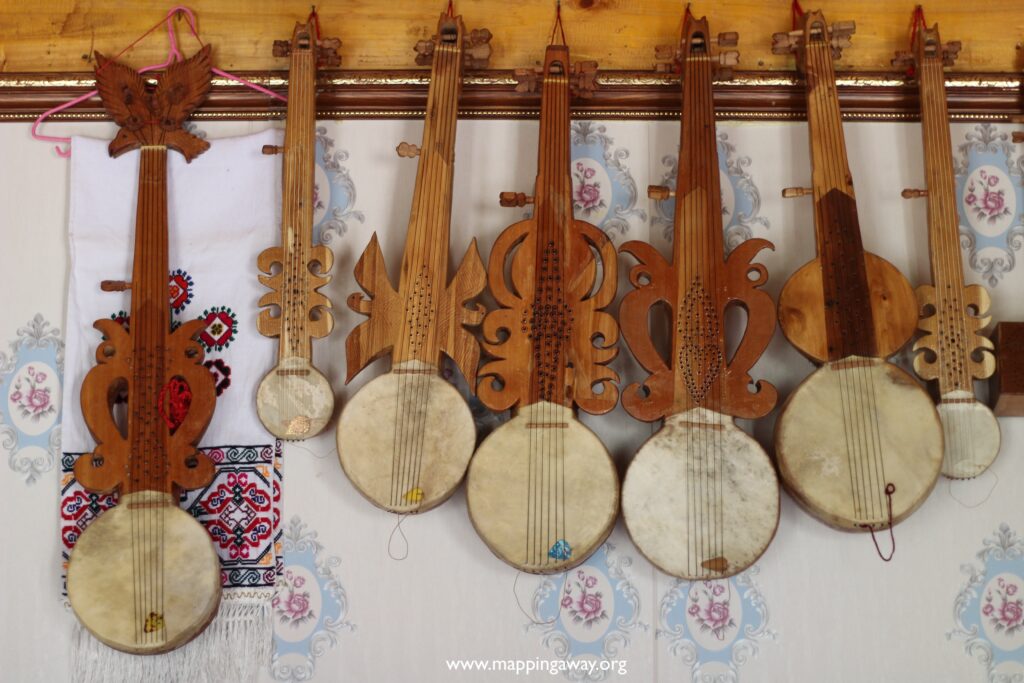
Grandpa is a musician and rubab maker (if I am wrong, can you tell me what instruments these are?). He plays them during festivals and celebrations. While visiting, he wanted to show me the instrument. Did any of the grandchildren inherit his talent? No. They are not showing any interest. The blanket and pillow embroidery, and wall decor are all stitched by hand by Grandma. I believe these are her handicraft collection for over the years.
Next Day…
The next day, while I was waiting by the bridge for transportation to the next village, I noticed a group of women dressed in black with white scarves. A moment later, I realized that Grandma was among them. They were returning from a nearby village, about a ten-minute walk from Da Tong Xiang, where a funeral had been held. People from neighboring villages, along with relatives, had gathered there to pay their respects.
Earlier, I had contacted the driver to ask whether he was heading to Taxian. He replied that he would ask around for me. The previous day, both the electricity and the phone network had gone out. As a result, the convenience store and restaurants could only accept cash, even though everyone was accustomed to paying with WeChat Pay.